Architecture
The Inshipia Security Gateway (ISG) is a daemon, isg serve. Operators reach it
over a local socket or a browser; it reaches the target hosts over SSH, and —
with Web Access — the web admin consoles over HTTP(S).
Everything else — the identity source, the mail relay, the optional back-ends —
hangs off that daemon and can be left out.
One daemon on one host is the shipped default, and everything below describes it. More than one daemon can serve the same estate at the same time, sharing their state rather than dividing the work; what that changes is set out under Running more than one gateway, and nothing else on this page assumes one or the other.
Components
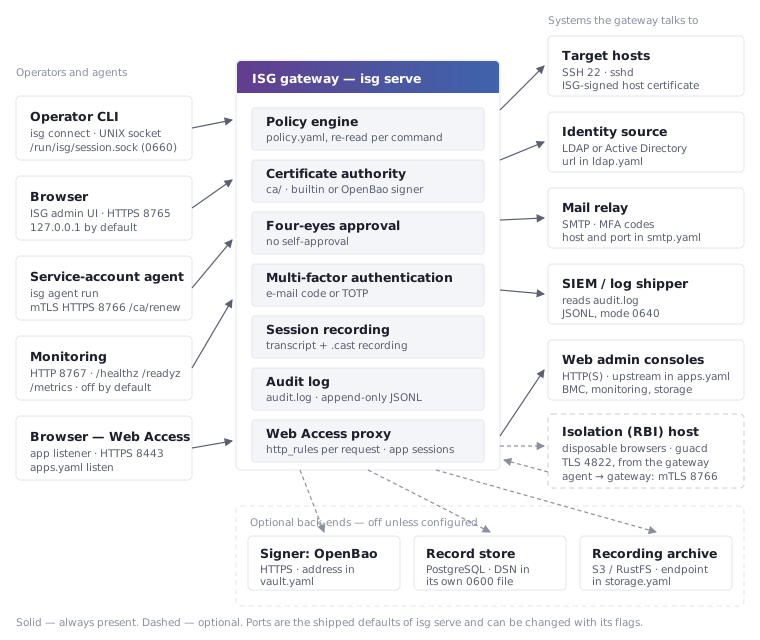
The gateway is the only thing that holds a credential for a target host, and it
holds each one for minutes. An operator's isg connect does not open an SSH
connection itself: it hands the request to the daemon over a local UNIX socket,
and the daemon establishes who is asking from the kernel — not from anything the
client says about itself. The browser reaches the same daemon on its own TCP
port for the admin view and the approval screens.
Web Access is the same gateway for web admin consoles — BMC interfaces,
monitoring and storage consoles. The browser reaches the gateway's application
listener (apps.yaml: listen) under the application's own host name; the
gateway checks the user against the application's groups, approval and incident
locks, evaluates every request against policy.yaml's http_rules, records it in
the session transcript, and only then forwards it to the console (upstream).
The console learns who the user is from a signed assertion (identity: jwt),
from nothing at all (identity: none), or not at all because the gateway signs
in with a shared account from OpenBao (identity: credential — a header, a basic
login, or the console's own login form with kind: form). With a form login the
console's session cookies stay in the gateway's memory: the browser holds only
the gateway's own application cookie.
An application set to mode: isolated does not open in the user's browser at
all. The gateway has an isolation (RBI) host start a disposable browser for the
session, sends the user only its picture over the Guacamole protocol (guacd,
rbi.yaml: agents), and takes the user's input back. The isolated browser
reaches the console only through the gateway. The RBI agent connects to the
gateways' renewal listener with mutual TLS (rbi-agent.yaml: brokers): its
commands, the browser's traffic and the recording upload all go that way, and
the RBI host holds no credential and no storage key.
Three systems are ordinary dependencies rather than options: the target hosts
(SSH), the identity source that resolves an operator to a directory identity and
its group memberships, and — if multi-factor codes go by e-mail rather than
TOTP — a mail relay. The audit log is a local file that a SIEM or log shipper
reads; an opt-in syslog copy (audit.yaml: syslog) can push every entry to a
SIEM as well, but the file stays the audit of record either way.
A fourth external system is optional and supplies only the login: an OIDC
identity provider, named in sso.yaml, behind the browser login to the admin
view and behind the device flow of the gateway login. It never supplies the
identity or the authorization — the name it returns is a lookup key, and the
directory gate stands exactly as it does for a password login.
The three back-ends drawn dashed are off unless a configuration file names them: an OpenBao instance as the certificate signer instead of the built-in one, PostgreSQL as the store for session and approval records instead of the local directory, and an S3-compatible object store as the archive for session recordings.
Dashed means optional for a single gateway. For more than one they are not: PostgreSQL is what the gateways share, and OpenBao becomes mandatory rather than merely available. A gateway that is named and uses PostgreSQL but not OpenBao refuses to start — see Running more than one gateway.
Connecting
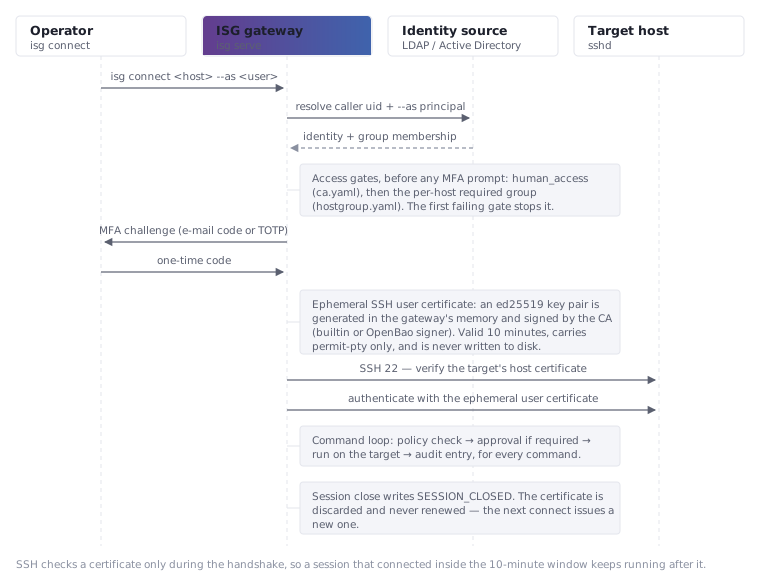
A connect is settled by the daemon in a fixed order, and the order is the point.
The caller's identity is established first, from the kernel-attested credentials
of the socket connection, and resolved against the directory. The two
non-interactive access gates — human_access in ca.yaml, then the per-host
required group in hostgroup.yaml — run next, so a request that was never going
to be allowed does not cost the operator a multi-factor challenge. Only then is
the challenge issued, and only after it succeeds does a credential exist at all.
Approving a command
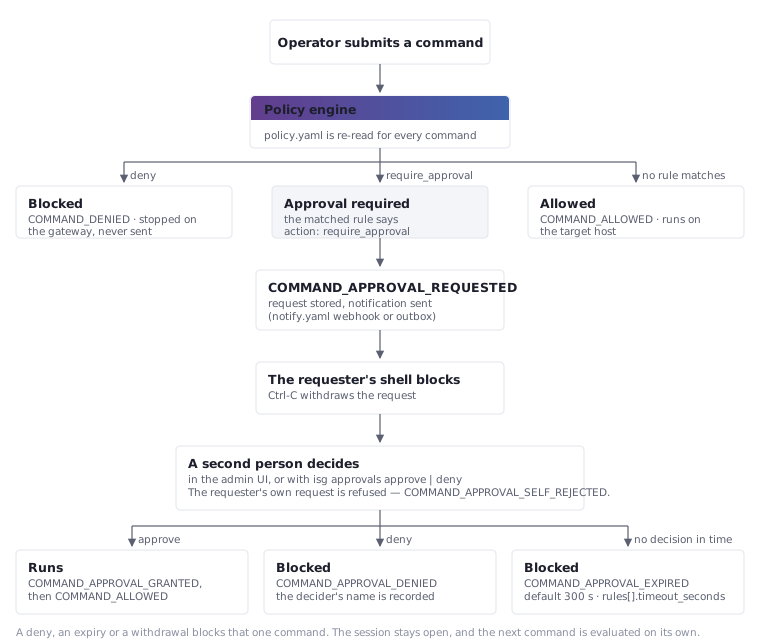
Every command in a session is evaluated on its own, against the policy file as
it reads at that moment — policy.yaml is loaded per command, so an edited
policy takes effect on the next command without restarting the gateway or the
session. A rule can deny the command outright or send it to a second person. A
command that matches nothing runs.
The built-in deny rules are part of every policy, including the policy of a
gateway with no policy.yaml at all, and a user rule cannot override them: the
file's own rules are evaluated between the built-in denials and the built-in
approval rules, and the first match wins.
Opening a web console
A user opens My applications in the admin view, which lists only the
applications their groups allow, and follows the application's link. The
application host has no session yet, so it sends the browser to the admin view
for a one-time hand-off: the user is already signed in there, and the hand-off
checks the groups, the incident locks and the licence again. An application
with require_approval asks for a duration first and waits for a second
person's decision (approval_mode: four_eyes), or opens at once on a stated
reason (approval_mode: self); either way the window has an end, and the
application session closes with it. From then on every request is decided on
its own: an incident lock, a lost group or an http_rules deny refuses it
before it reaches the console, a step_up rule asks for a fresh second factor,
and every request — allowed or not — is a line in the session's transcript.
State
Running more than one gateway
Several gateways can serve one estate at the same time. They are peers: each one runs every role — the admin view, session brokering, CA operations, approvals — and none of them is a standby. What makes them one system rather than several is that they share their state.
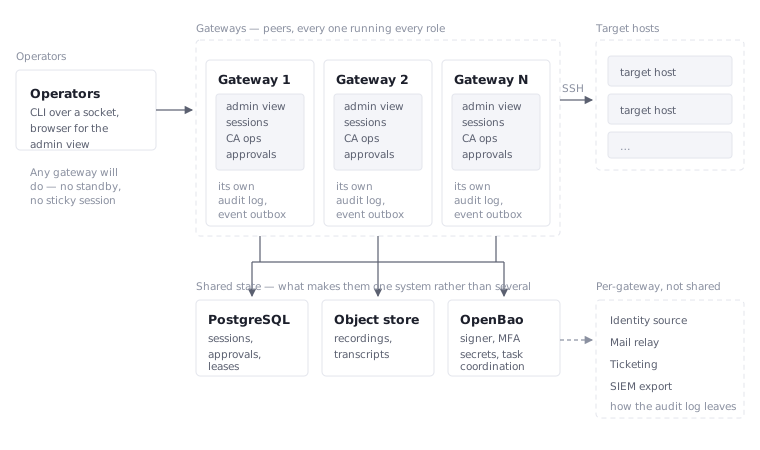
What that buys is that losing a gateway does not close the door: operators keep opening sessions through the ones still standing. What it does not buy is the survival of sessions already running on the gateway that was lost. A live session is an SSH stream and a PTY on that particular machine; when the machine goes, the stream goes with it, and the operator opens a new session through a peer. The record does survive — a surviving gateway marks the session ended rather than leaving it open — so the audit trail has no gap.
Three things carry that shared state, and two things stay local no matter how many gateways there are:
| What | One gateway — local, under $ISG_HOME |
Shared layout | Switch |
|---|---|---|---|
| Session and approval records | sessions/, approvals/ |
PostgreSQL | storage.yaml: records.backend |
| Broker leases, lockouts, revocations, login state, gateway tasks | one directory per record family | PostgreSQL — the same store, the same switch | storage.yaml: records.backend |
| Recordings and transcripts of closed sessions | recording-<SESSION-ID>.cast, transcript-<SESSION-ID>.jsonl |
S3-compatible object store | storage.yaml: recordings.backend |
| The SSH certificate signer | ca_key under ca/ |
OpenBao — the private key is never opened or required on a gateway: a seeded secondary has no ca_key at all, only the pinned ca_key.pub; the primary keeps the copy it imported into the OpenBao |
ca.yaml: signer |
| Multi-factor secrets | totp/ |
OpenBao (KV) | mfa.yaml: store |
| The audit log | audit.log |
local on every gateway, always | — |
| The X.509 CA, the public mirror, the state-root lease, the event ticket outbox | ca/, pub/, serve.lease, ticket_outbox/ |
local, always | — |
A local directory in place of any of the shared rows is a single-gateway
layout, not a shared one, and putting that directory on a network file system
does not make it shared: serve.lease records which host owns the state root,
and a gateway on another host refuses to start on it.
Each gateway carries a name of its own — broker.yaml's id, one to eight
alphanumeric characters — and stamps it onto every session record and every
audit line, so a record read from the shared store says which gateway produced
it. isg system brokers lists the fleet.
Two of the startup refusals in Fail-closed posture exist for this layout. The first is that an unnamed gateway will not join a store another gateway is already using. The second is that a gateway which is both named and pointed at PostgreSQL must also use OpenBao for signing and for multi-factor secrets. The reason is that the alternatives are correct alone and quietly wrong together: the built-in signer counts certificate serials per process, so two gateways can issue the same serial to different certificates and a revocation list stops naming one certificate; and a multi-factor secret written to one gateway's disk does not exist on its peers, so an operator who enrolled on one cannot log in through another. Both failures would appear far from their cause — at a revocation that does not bite, at a login that does not work — which is why the check happens at startup instead.
Some things stay local on purpose. Each gateway writes its own audit log: the file is append-only by contract, and a shared writer would trade that contract for convenience. The fleet-wide view is assembled by exporting the lines, not by pooling the file. The event ticket outbox is local for the same reason a shared one would need a shared record to hang the work on, and a revocation has none. A gateway that goes down therefore leaves its own event tickets until it returns — a delay, not a loss, and the audit log covers the gap. Session tickets are the opposite case: they hang off the shared session record, so a peer picks up an interrupted one after fifteen minutes.
For the operator, two consequences are worth planning around. The admin view keeps its login state in the shared store, so gateways can sit behind one name or a load balancer with no sticky-session requirement. And the probe rate against a target multiplies by the number of gateways: the interval that keeps probes from tripping a target's lockout is enforced per gateway, deliberately, because it is a load property rather than a correctness one.
Fleet topology
Everything above describes one gateway. An estate in production is a small fleet, installed by the Ansible playbooks: the gateways, plus the hosts that carry their shared state, their identity source and their monitoring. This section names those host roles, which port each one opens, and to whom. The gateway's own ports and sockets stay under Network and ports below.
A typical estate: two brokers, one shared store, one directory host, one monitoring host and any number of target hosts.
Host roles
| Role | Inventory group | What runs there | How many |
|---|---|---|---|
| Broker | isg_brokers |
The gateway itself (isg_gateway, isg_broker_e1) and the break-glass log receiver (isg_breakglass_receiver). When a VIP is configured, isg_keepalived holds it — installed after the main run, once every broker is healthy |
Two or more; they share state, not work |
| Shared store | isg_store |
PostgreSQL for the session records, RustFS (S3) for the recordings, and OpenBao (isg_shared_store, isg_bao_init) |
One |
| Directory host | isg_infra |
OpenLDAP, Keycloak and Mailpit (isg_directory). Mailpit is a test mail sink only: it receives the multi-factor codes over SMTP |
One |
| Monitoring host | isg_monitoring |
Prometheus and Grafana (isg_monitoring) |
One |
| Isolation (RBI) host | isg_rbi |
The RBI agent, guacd and the disposable browser containers (isg_rbi) — only when an application uses mode: isolated |
Optional; one or more |
| Target host | isg_targets |
The customer's servers. The playbooks set them up for certificate login and break-glass access (isg_target_host, isg_breakglass_target); their host firewall stays with the customer's own baseline |
Any number |
| Jump host | isg_jumphost |
An optional host that testers log in from. Its playbook is separate and is not part of the gateway installation | Optional |
| Controller | — | The machine that runs Ansible. It is not an inventory host | One |
Every broker, store, directory and monitoring host also gets the firewall
baseline (isg_firewall) and the node exporter (isg_node_exporter). The
target hosts get neither: they belong to the customer.
Service, port and source
Each row is a firewall rule per source, opened by the role that owns the port. An empty source list opens nothing — it never means "everyone".
| Port | Where | Opened by | Source |
|---|---|---|---|
| 22 (SSH) | brokers | isg_firewall |
isg_net_admin_sources and isg_net_user_sources — on a broker, port 22 is also the gateway login |
| 22 (SSH) | store, directory, monitoring | isg_firewall |
isg_net_admin_sources |
| VRRP (IP protocol 112) | brokers | isg_firewall |
the other broker, only when isg_vip_address is set |
| 8765 (admin view) | brokers | isg_gateway |
isg_net_user_sources and the other brokers (for the fleet-wide self-check) |
8444 (Web Access application listener, isg_apps_port) |
brokers (and the VIP) | isg_gateway |
isg_net_user_sources — only when Web Access is on (isg_cfg_apps or a dynamic-app domain is set) |
| 8766 (certificate renewal, mutual TLS) | brokers | isg_gateway |
isg_net_target_sources, the RBI hosts (isg_rbi) and the other brokers |
| 8767 (diagnostics and metrics) | brokers | isg_broker_e1 (from diag.yaml's listen) |
isg_monitoring_host and the other brokers |
| 9100 (node exporter) | every fleet host | isg_node_exporter |
isg_monitoring_host |
| 5432 (PostgreSQL, session records) | store | isg_shared_store |
the brokers |
| 9000 (RustFS S3, recordings) | store | isg_shared_store |
the brokers |
| 8200 (OpenBao) | store | isg_shared_store |
the brokers |
| 4822 (guacd, TLS) | RBI hosts | isg_rbi |
the brokers only; with an empty list the role does not open the port, and says so |
| 636 (LDAP over TLS) | directory host | isg_directory |
the brokers |
| 389 (LDAP, unencrypted) | directory host | isg_directory |
the brokers — only during the transition phase; once the directory is TLS-only, the port is not published at all |
| 1025 (SMTP, multi-factor codes) | directory host | isg_directory |
the brokers |
| 8443 (Keycloak HTTPS) | directory host | isg_directory |
isg_net_user_sources and the brokers (the browser, and the daemon's discovery and key fetches) |
| 8025 (Mailpit web view) | directory host | isg_directory |
isg_directory_firewall_admin_sources (default isg_net_admin_sources) and, when Mailpit is a Web Access application, the brokers (isg_directory_firewall_mail_ui_app_sources) |
| 3000 (Grafana) | monitoring host | isg_monitoring |
isg_monitoring_firewall_admin_sources (default isg_net_admin_sources) and, when Grafana is a Web Access application, the brokers (isg_monitoring_firewall_app_sources) — the reference environment opens it to the brokers only |
| 9091 (Prometheus) | monitoring host | isg_monitoring |
the same two lists as Grafana |
| 20514 (break-glass log receiver, TCP syslog) | brokers | isg_breakglass_receiver |
isg_net_target_sources — the target hosts send the break-glass lines. Here an empty list stops the run: a receiver no line can reach would only show up as a warning that never clears |
SSH from a broker to a target host depends on the target's firewall, which is
the customer's. Grafana reaches Prometheus on its own host over localhost, so
no rule is needed for it.
Network
The installation has one network input: four values and a switch in the environment's group variables.
| Variable | Meaning |
|---|---|
isg_firewall_enabled |
Whether the firewall baseline runs in this environment |
isg_net_admin_sources |
Sources for SSH and the admin consoles |
isg_net_user_sources |
Sources for the browser (admin view, Keycloak) and the gateway login on the brokers' port 22 |
isg_net_target_sources |
The target hosts, for certificate renewal and the break-glass log |
isg_vip_address |
When set: VRRP is allowed between the brokers, and this is the address isg_keepalived brings up |
Every other address comes from the inventory: the brokers' addresses and the monitoring host. Host names may resolve through any resolver, but the addresses the roles use do not depend on it: they are written out in the inventory. A host certificate's IP principal is not something the run can discover on the host, and on a host with more than one network leg the default address is not necessarily the one a broker dials.
Network and ports
Ports are the shipped defaults; each is a flag on isg serve or a key in a
configuration file. The gateway's own local sockets are listed with them,
because from an operator's point of view they are the same kind of thing: a
door into the daemon. Where more than one gateway runs, each binds its own
copy of every row below.
| Direction | Port or path | Protocol | When it is needed |
|---|---|---|---|
| Browser → gateway | TCP 8765 (--bind 127.0.0.1, --port 8765) |
HTTPS once the CA is initialized, plain HTTP before that | Always — the admin view and the approval screens |
| Browser → gateway (Web Access) | TCP 8443 (apps.yaml: listen; the playbooks set 8444) |
HTTPS, with the certificate in apps.yaml: tls_cert_file (a *.<dynamic_apps_domain> SAN for webUI-managed applications) |
Only when apps.yaml names an application or a dynamic-app domain |
| Renewal agent → gateway | TCP 8766 (--ca-renew-bind 0.0.0.0, --ca-renew-port 8766; the agent dials agent.yaml: ca_renew_url) |
HTTPS with mutual TLS | Only for service-account certificate renewal, and only started once the CA is initialized |
| Monitoring → gateway | TCP 127.0.0.1:8767 (diag.yaml: listen) |
HTTP — /healthz, /readyz, /metrics |
Only when diag.yaml sets enabled: true; no socket is bound otherwise |
| Operator CLI → gateway | /run/isg/session.sock (mode 0660) |
local UNIX socket | Always — this is the session path |
| Operator CLI → gateway | /run/isg/issue.sock (mode 0600) |
local UNIX socket | Certificate issuance, MFA enrolment and reset, approval decisions, closing a session |
| SSH login account → gateway | /run/isg/gateway.sock (mode 0660, group isg-gateway) |
local UNIX socket | Only when an identity source is configured |
| Gateway → target host | TCP 22 | SSH | Always |
| Target host → break-glass log receiver | breakglass.yaml: breakglass_log_target (the brokers' receiver: TCP 20514, or a SIEM) |
syslog, over TCP unless breakglass_log_protocol is udp |
When break-glass forwarding is set up: the target hosts' break-glass login and command trace |
| Gateway → identity source | the port in ldap.yaml's url |
LDAPS (ldaps://, 636) is the recommended mode; LDAP with StartTLS (start_tls: true, 389) is equivalent in strength. An unencrypted connection needs allow_plaintext: true to say so, and the daemon refuses to start without it — so a directory should not offer its unencrypted port to the network at all |
When ldap.yaml is present |
| Gateway → mail relay | smtp.yaml: host, port |
SMTP, with STARTTLS when tls: true |
When multi-factor codes are delivered by e-mail |
| Gateway → OpenBao | vault.yaml: address |
HTTPS | When ca.yaml sets signer: vault, or mfa.yaml sets store: vault |
| Gateway → PostgreSQL | the connection string named by storage.yaml's records.postgres.dsn_file |
PostgreSQL | When records.backend is postgres |
| Gateway → object store | storage.yaml: recordings.s3.endpoint |
HTTPS (S3 API) | When recordings.backend is s3 |
| Gateway → SIEM | audit.yaml: syslog.address |
RFC 5424 syslog over TCP with TLS | When syslog.enabled is true — an opt-in copy of the audit log, never the record itself |
| Gateway → identity provider | sso.yaml: issuer (OIDC) or saml_idp_metadata_url (SAML) |
HTTPS (OIDC discovery, token and device endpoints; the SAML IdP metadata) | When sso.yaml sets enabled: true |
| Gateway → web console | apps.yaml: each application's upstream (apps[].upstream) |
HTTP or HTTPS (upstream_ca_file for a private CA) |
For every proxied Web Access request, and for the gateway's own sign-in of a kind: form account |
| Gateway → OpenBao (Web Access accounts) | vault.yaml: address, path <kv_mount>/data/<prefix>/<app>/<name> (<prefix> is apps.yaml: credential_kv_prefix) |
HTTPS | When an application uses identity: credential; the broker only reads |
| Gateway → RBI host | rbi.yaml: agents[].guacd (TCP 4822) |
Guacamole protocol over TLS, the server checked against guacd_ca_file |
Only when an application uses mode: isolated: the isolated browser's picture and the user's input |
| RBI agent → gateway | rbi-agent.yaml: brokers (TCP 8766, the renewal listener) |
HTTPS with mutual TLS | Only on an RBI host: the agent's commands, the isolated browser's traffic to the console (through the gateway) and the recording upload |
| Gateway → Jira | jira.yaml: endpoint |
HTTPS (Jira REST API) | When jira.yaml is configured and not disabled: the session tickets |
| Gateway → webhook | notify.yaml: webhook.url |
HTTPS, a JSON POST | When notify.yaml sets a webhook: each new approval request |
The socket paths above are the system-service layout. When XDG_RUNTIME_DIR is
set — a per-user daemon, typically during evaluation — the daemon binds
$XDG_RUNTIME_DIR/isg/<name>.sock instead, and the CLI looks for
/run/isg/<name>.sock first and falls back to the per-user path.
Two of these ports face the network by default and two do not, and the difference is deliberate. The admin view binds loopback until you widen it, and widening it is refused unless authentication and TLS are both in place (see Fail-closed posture below). The renew endpoint binds all interfaces because a renewal agent runs elsewhere by definition; its protection is mutual TLS, not the bind address. The diagnostic listener is loopback and disabled, on the assumption that the monitoring agent runs on the same host.
Certificate lifecycle
The gateway runs its own certificate authority, initialized once with isg ca init. It signs four different things, with four different lifetimes, and the
differences follow from what each credential is for.
The human access certificate is what a session is actually built on. When a
connect passes every gate, the daemon generates a fresh ed25519 key pair in its
own memory, signs an SSH user certificate over it, and dials the target with
that. It is valid for exactly ten minutes — five minutes either side of
issuance, a window sized for clock drift during the handshake and nothing else —
carries the permit-pty extension and nothing more, and is never written to
disk. Neither the key nor the certificate is ever handed to the operator.
A service-account access certificate (isg ca issue --account <account> --host <host>) is the machine equivalent: one hour by default, or whatever
ca.yaml's service_accounts[].ttl_seconds says for that account.
A renewable identity is the X.509 client certificate a service machine holds
so its agent can renew access certificates over the mutual-TLS endpoint. It is
issued by redeeming a one-time join token (isg ca join-token redeem --token <token>; the token itself defaults to fifteen minutes) and lasts thirty days
unless ca.yaml's renewable_ttl_days says otherwise. The private key is
generated on the service machine and never crosses to the gateway.
A host certificate (isg ca host-cert issue --host <host> --key <file>) is
what lets the gateway recognise a target host. It is signed over the target's
existing host public key — the CA never sees the host's private key — and lasts
one year by default (ca.yaml: host_cert_ttl). There is no renewal agent on
the target side, so the model here is a long lifetime plus revocation rather
than short-lived rotation.
The signer behind all of this is chosen by ca.yaml's signer key: builtin,
which opens the CA private key on the gateway, or vault, which delegates the
signing to OpenBao and never opens a local key at all. The gateway's own TLS
server certificates — for the admin view and for the renew endpoint — are
derived from the same CA and last ninety days.
What happens at expiry differs by credential, and one case surprises people.
SSH checks a certificate's validity only during the handshake. A session that
connected inside its ten-minute window therefore keeps working indefinitely
afterwards; there is no renewal and no mid-session re-issuance, by design. The
lever for cutting a human off is refusing the next issuance — that is what the
access gates do — not invalidating a certificate already in use. For the
long-lived credentials it is the other way round: isg ca revoke --account <account> and isg ca host-cert revoke add a serial to the gateway's
revocation list, which is consulted on every renew request and every dial, with
no cache to go stale.
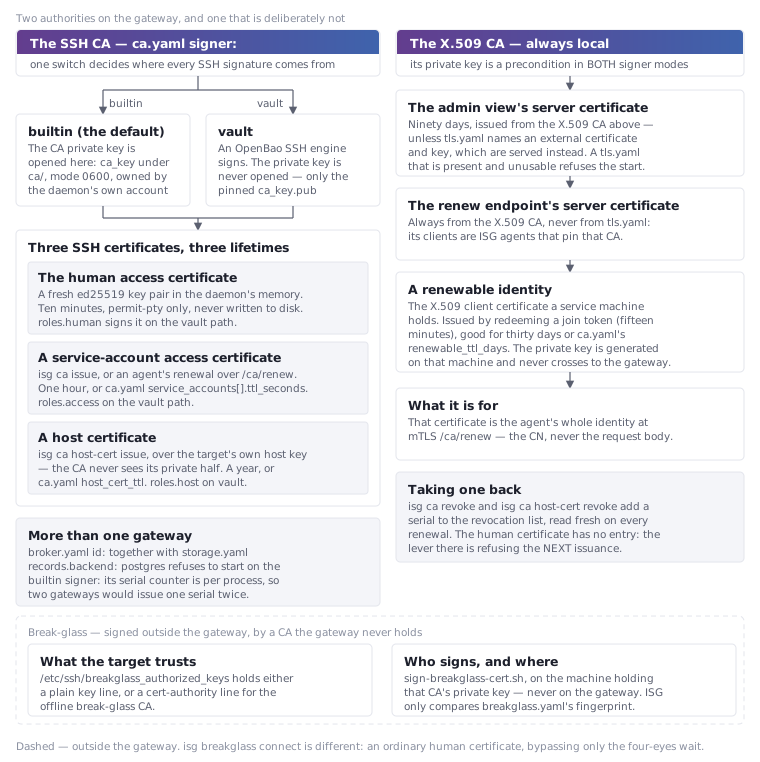
The diagram keeps apart what the paragraphs above necessarily run together. The left column is one switch and everything downstream of it. The right column is an authority that switch never moves, which is why a gateway signing through OpenBao still keeps a private key of its own on disk. The dashed band is a third CA, drawn outside both columns because that is where it lives — on a machine this gateway cannot reach, and whose signatures it never produces.
Data at rest
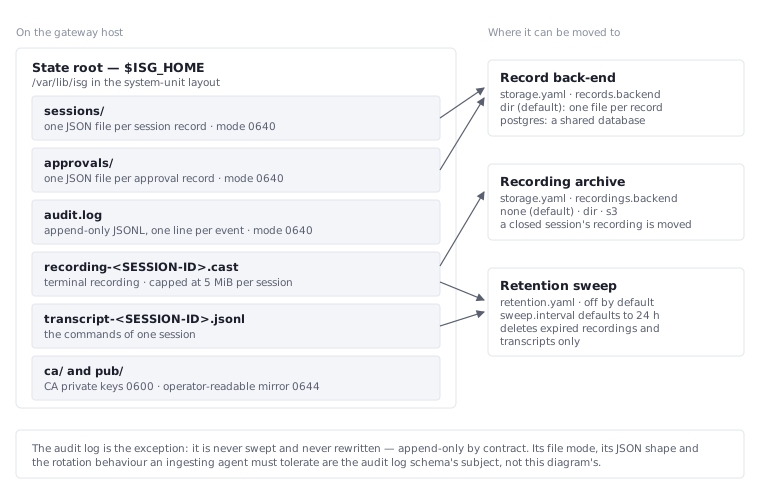
Everything the gateway persists lives under one directory: $ISG_HOME, which
is /var/lib/isg in the system-service layout. Configuration and state share
it. Every configuration file is optional — a state root with no files at all is
a valid first-run state — and each loader defines what its own file's absence
means. The configuration reference lists every file and
every key in it.
The state, as opposed to the configuration:
| Path | What it holds |
|---|---|
sessions/ |
One JSON file per session record, mode 0640 |
approvals/ |
One JSON file per approval record, mode 0640 |
audit.log |
The audit log: append-only JSONL, one line per event, mode 0640 |
recording-<SESSION-ID>.cast |
The terminal recording of one session, capped at 5 MiB |
transcript-<SESSION-ID>.jsonl |
The commands of one session — for a Web Access session, one line per request (method, path, status, the brokered account; with record_body, the masked body of a changing request) |
apps-dynamic/ |
The applications managed on the web UI's Manage apps page (a record family, PostgreSQL in a fleet) |
ca/ |
The CA's own key material — private keys mode 0600 |
pub/ |
The operator-readable mirror of the CA's public artifacts, mode 0644 |
serve.lease |
Which process currently owns this state root |
totp_outbox.txt |
Multi-factor codes, when no mail relay is configured |
ticket_outbox/ |
Ticket intents waiting to be retried |
A kind: form account's upstream session cookies are deliberately not on this
list: they live in the gateway's memory only, per application session, and a
restart or a move to another gateway signs in again.
Which of these leave the directory for a shared store, and which never do,
is the table under Running more than one gateway. retention.yaml turns on
a periodic sweep that deletes expired artifacts — every 24 hours unless
sweep.interval says otherwise, and off entirely unless sweep.enabled is
set. Which gateways are alive across the fleet is a record in the shared
store, and isg system brokers is what reads it.
The audit log is the exception to all of it. It is never swept, never rewritten and never moved: it is append-only by contract, and the contract — the JSON shape of a line, the file's mode, the rotation behaviour an ingesting agent must tolerate — is set out in the audit log schema.
Fail-closed posture
The gateway refuses to start rather than start in a state that looks correct and is not. That is a deliberate trade: a refusal is seen by the operator doing the restart, whereas a silently disabled control is seen by nobody until it matters.
isg serve will not come up when:
- a configuration file has a top-level key it does not recognise. Any registered file, checked before anything else is opened, with no escape switch. A mistyped key that was quietly ignored would produce a gateway that starts cleanly and enforces something other than what the file says.
retention.yamldoes not parse. A retention rule nobody can read is worse than no rule at all, because it looks like one.- another daemon already owns the state root. Two daemons over one directory
do not corrupt each other's records; the second one silently discards the
first one's sessions. The lease is what prevents that, and
isg system lease statusis what explains a refusal. - an unnamed gateway tries to join a store another gateway is using.
Records from a gateway with no
broker.yamlidcannot be told apart from its peers' afterwards, and the shared store is exactly where that matters. - a gateway is named and uses PostgreSQL, but not OpenBao.
ca.yaml'ssignerandmfa.yaml'sstoremust both bevaultin that layout. The message names every violation at once — the file, the current value, the required one and why — rather than one per restart. See Running more than one gateway for what goes wrong otherwise. - the audit log cannot be opened, or
audit.yamldoes not parse. - a named back-end cannot be built. A
records.backendor arecordings.backendthat ISG cannot construct is a refusal, not a quiet degradation to local storage — the separation the operator asked for either exists or the gateway says so. mfa.yamlnames a mode that does not exist, or the multi-factor secret store cannot be built.connect.yamlnames an unknownhost_key_checkvalue. There is no falling back to a permissive setting.- a non-loopback
--bindis asked for without authentication or without TLS. Both are required together; either one missing is a refusal that names what is missing.
Two more cases are refusals at request time rather than at startup. If the
directory lookup for a requested --as principal fails for an infrastructure
reason — not "no such user", which is survivable — the daemon denies the
session rather than continuing with empty group memberships and hoping a rule
lets it through. And break-glass, the mechanism that bypasses the four-eyes
gate, is denied to everyone when no breakglass_group is configured; there is
no reading of "unset" that makes it permissive.
Two things are not fatal. The first is an uninitialized CA: the daemon starts,
says so, and does not open the renew endpoint; the CA administration operations
stay unavailable until isg ca init has run. The second is an identity provider
that cannot be reached at startup: the daemon starts without SSO — the password
form stays, even under web: required — and the SSO (OIDC) row of
isg system check says so until the provider is back. Whether anyone can enter
a running gateway must not depend on a JSON document being fetchable.